
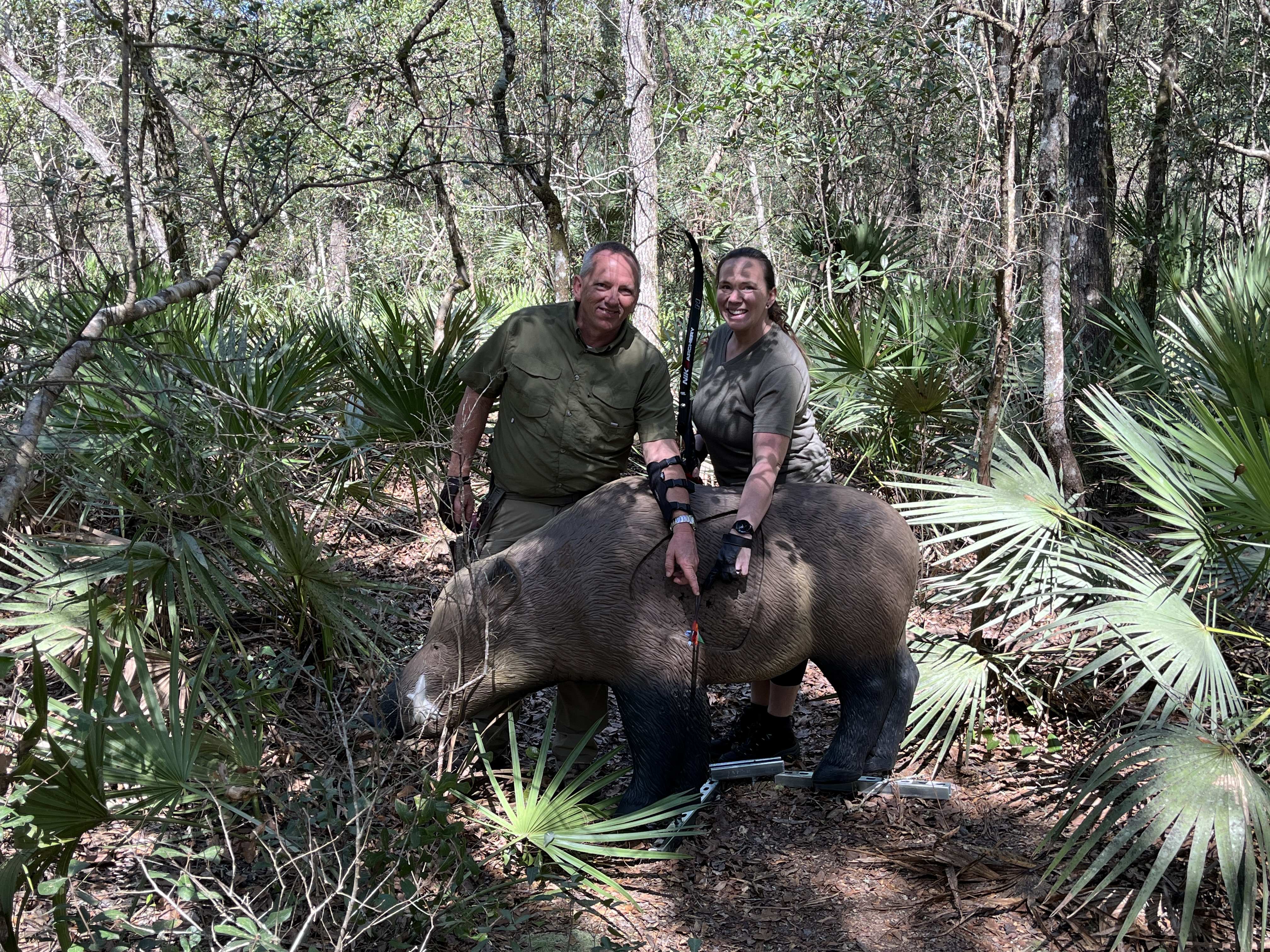
This Spring we attended the TBOF (Traditional Bowhunters of FL) 3-D Archery Shoot. We have been attending this shoot for 18 years now. It is the first archery shoot of any kind that we had ever participated in. We had been shooting in the backyard for a few months, when I stumbled across the flyer on a traditional archery website for the TBOF State Championship. It sounded very interesting and was only about 40 minutes from the house. Free primitive camping was offered and that was all it took for Amanda and I to decide to try this new adventure.

What Is 3-D Archery
3-D archery is a version of the sport where you shoot at life like 3-D animal targets made from self healing foam. They can be indoor ranges or outdoor ranges . Outdoor range targets are usually set in a natural setting with the targets positioned on shooting lanes that run perpendicular to designated trail. As you walk the trail you stop at each lane and shoot the target from the stake that is designated for the class you are competing in. Most Traditional 3-D shoots consist of Cubs (up to age 11), Youth (12-16), Women’s and Men’s classes, with the Women’s and Men’s classes divided by the type of bow they are shooting, such as longbow, recurve or primitive. This is done so you are competing against archers using similar gear as you. We have only shot outdoor 3-D ranges. Mostly because we shoot traditional archery and they are outdoor ranges, but compound shooters have opportunities to shoot both indoor and outdoor ranges.

Practical Beginnings of 3-D Archery
3-D Archery Shoots started as a way for bowhunters to hone their archery skills in the spring and summer to prepare for hunting season in the Fall and Winter. Ranges were set with animal targets that hunters hopefully would encounter during actual hunting season, like deer, elk, hogs, turkeys and occasionally bears. Targets were set at distances similar to hunting situations. Fifteen to twenty-five yard shots, with an occasional longer shot on a bigger target like an elk or a shorter shot on a small target like a coon or turkey.
The first TBOF shoot we attended was heavy on middle to late middle aged male shooters. In other words…bowhunters. There were some women and children, but generally they were the family of bowhunters, and in some cases, bowhunters themselves. But as time passed and archery grew in popularity, especially among young girls( think Katniss Everdeen and Disney’s Merida), the crowd began to change to a more inclusive and family oriented event. There are still plenty of bowhunters participating, but they are more likely to bring family and friends for some all inclusive fun and friendly competition.

The group of five friends we have shot with over the years has grown to include spouses, children, and grandchildren, as well as various friends and assorted family. Where we used to shoot as one group, we now have to shoot as three and sometimes four groups. Most events prefer groups of not more than six and no less than three. Overly large groups tend to slow the flow of the range and cause delays. But we still congregate to catch up and tell stories of our glory days over shared meals and a cozy campfire.

How To Score 3-D Archery
There are 2 major archery organizations involved in competitive 3-D archery, ASA and IBO. There are also numerous 3-D archery shoots sponsored by state, regional and local clubs. Each can have it’s own method of scoring targets. But, all are based on the same principal, the more ethical or lethal the shot would be in the real world, the better the score in the 3-D world.

One of the main goals in bowhunting or any hunting for that matter, is to be proficient enough at shooting as to make the best possible shot on an animal, so that the kill is clean and humane. Scoring in 3-D archery mirrors this goal. The best shots receive the highest points. Arrows in the kill zone, which is an outline of the lungs earn a higher value than an arrow in the leg. Arrows in the heart score higher than the lung.
Each event can be slightly different on how they score. Always ask officials when you register how the scoring works. They usually have a diagram somewhere that spells it out. Confirm what color stake you should shoot from at the same time.
What To Expect

We are going to discuss Traditional 3-D archery shoots, because I have never attended any other kind. Events can be a one day shoot at a local club or an all weekend process sponsored by a larger organization. These events are usually held in a rural area as they require a lot of space to allow safe distances between and behind the targets. First thing to do is register as a participant. Simple enough, there will be someone helping with that. You will need to provide some basic information and , of course, sign a waver. Generally, there will be a fee to shoot, between $20 and $30. You should ask about scoring and which stake you will be shooting from. You will be given scorecards to keep track of your score. From here you can head to the practice range. Most events have a static target range at which you can warm up before heading to the 3-D range. Once you make it to the 3-D range you will shoot as part of a group, generally consisting of 3-6 archers. If you are with a group of family or friends you are ready to go. If not, you can join with other archers to form a group. We have met many, many great people over the years by joining with their group.

At the range the process is similar to a round of golf. Except instead of holes there are three dimensional targets and you only get one shot per target, not however many it takes. From the appropriate stake at the target, each archer takes their best shot one at a time. Once all shooters are finished shooting, the group goes to the target to record the scores, retrieve their arrows and move to the next target. A round can consist of 20 to 30 targets.

TBOF’s spring shoot is the Florida Championship. It consists of two twenty target rounds on Saturday and one round on Sunday. For Sunday’s round you get paired with archers shooting the same division and with similar scores as yourself. I have never placed at TBOF. Long ago I came to the conclusion that to place I would have to have the best day of my life and 5 or 6 of the top shooters would have to carpool to the shoot…and break down on the way. Ok, maybe 7 or 8 of the top shooters. My oldest granddaughter Emily, on the other hand is doing very well. This year she transitioned from Cub to Youth and still won her division. Again, further proof I am a better teacher than shooter. This year we included the next two grandchildren, Skylee and Grayson, both Cub shooters. And although they didn’t place, they both did pretty good and I think they had a lot of fun, which is after all the main goal.

Extra Activities
Sometimes larger 3-D archery shoots will have additional smaller ranges set up for specific purposes. One of my favorites is the Coon Shoot. You may also find an Iron Man Shoot or a Distance shoot. Or maybe a Last Man Standing Shoot or Poker Shoot. These side shoots usually are designed to give archers something to fill vacant time at an event. Often larger shoots will have vendors selling everything from archery gear to handcrafted jewelry. Its a good opportunity to put your hands on a new bow or other gear. Most vendors will let you test shoot a prospective new bow.
Coon Shoot
This is a contest held after dark, much like it’s namesake, coon (raccoon) hunting. Smaller coon and coon sized targets, usually 10, are set up at shorter distances (10-15 yards) and the participants shoot in the dark for their best score. Glow sticks are placed in the dead center of the kill zone for a point of reference. Archer with the highest score wins.
Ironman Shoot
This shoot is named not after the armor encased Avenger, but after the skill level of the shots. An Ironman course will consist of 10 extremely challenging targets. Targets will be obstructed be foliage, vines, limbs, trees and sometimes…iron, so that only a small path exists to the kill zone. And if that is not tough enough, you only get one arrow to complete the course with. If you loose or break your arrow, you are done shooting and score the points you have earned up to that point. The archer with the highest score wins.

Distance Shoot
One target, usually a large one, like a moose or elk, is placed at a distance much farther than average. This distance maybe 60 yards or more, three times the average shoot on the competition range. Shooters will shoot at a marked spot in the dead center of the kill zone. This shoot is usually done as a group and archers shoot three arrows per turn. Arrow closest to the marked spot wins.

Last Man Standing
Shot as a group, Last Man Standing is where each archer shoots at a spot on a 3-D Target that is called by the judge running the shoot. Usually there are 5-6 targets set at 12-25 yards. And the judge will select the shot like; deer target in the kill zone, and each participant will try to make the shot as called. Those that do progress to the next shot. And those who don’t make the shot are out. As the contest continues the shots get harder. The judge may call shooting a target in the head or back leg. The winner is the last man or woman to not miss a shot.

Poker Shoot
In this shoot, a deck of cards are positioned face up on a large target. Each archer shoots five arrows with the intention of making the best poker hand he or she can with the cards their arrow hits. At the end of the shoot the archer with the best poker hand wins. Ties are broken by shooting another hand.

Find a Shoot Near You
3-D shoots start in early spring and continue through summer. In certain areas you can find shoots almost every weekend. Almost every state has a championship shoot and there are some really big shoots that are annual occurrences. Cloverdale, ETAR, and Compton are the largest annually occurring shoots and all three are still on my bucket list. Try this website for a searchable data base. Also try searching facebook for 3D archery shoots. Check with your local archery store, range or club for local shoots.
3-D archery is quite a challenge. Each target can be a different size depending on the animal or in a different pose. The distances vary from target to target and is almost always unknown. You may shoot a bobcat target at twelve yards, followed by an elk target at 25 yards. Amanda and I have come a long, long way from our first 3-D shoot. We lost so many arrows we had to buy more just to finish the course. And for a long time, a successful shoot was one where we came home with the same number of arrows we started with.
As a discipline of archery, traditional archery is my choice and 3-D shoots are by far my favorite way to practice my craft. This is a good chance to test your skills against your fellow competitor and more importantly yourself. Lost arrows aside, 3-D archery is a lot of fun and the people who participate have proven to be some of the best people I have ever met, many of which I call friends.
Frequently Asked Questions About 3D Archery
What is 3D archery and how is it different from target archery?
3D archery is a style of archery where shooters aim at life sized foam animal targets placed at varying distances in a natural outdoor setting. Unlike standard target archery with flat paper targets at known distances, 3D archery uses realistic animal shapes and often unknown distances, which adds a hunting style challenge and makes it more dynamic and realistic.
Do beginners need hunting experience to try 3D archery?
No, beginners do not need any hunting experience to enjoy 3D archery. Many events are designed for all skill levels, including youth and first time shooters. Beginners are placed in appropriate divisions and shoot from closer distances to match their ability, making it a great way to learn archery in a fun and supportive environment.
How is scoring done in 3D archery competitions?
Scoring in 3D archery is based on where your arrow hits the target, with higher points awarded for shots in the most vital areas, often called the kill zone. These zones represent ethical hunting shot placement, such as the heart and lungs. Less accurate shots outside these areas receive fewer points, and each event may have slightly different scoring rules depending on the organization.
Additional Archery Learning
- Archery Lessons: How To Find The Best Instruction
- Why Archery is the Best Sport for Kids
- Where To Start When Buying Your First Archery Bow
- 3 Ways To Determine Eye Dominance in Archery And Why It’s Important
- 3 Ways To Determine Your Archery Bow Draw Length
- Archery Basics: How to Determine What Draw Weight Is Right For You
- Beginners Guide To The Four Basic Types Of Archery Bows


Leave a Reply